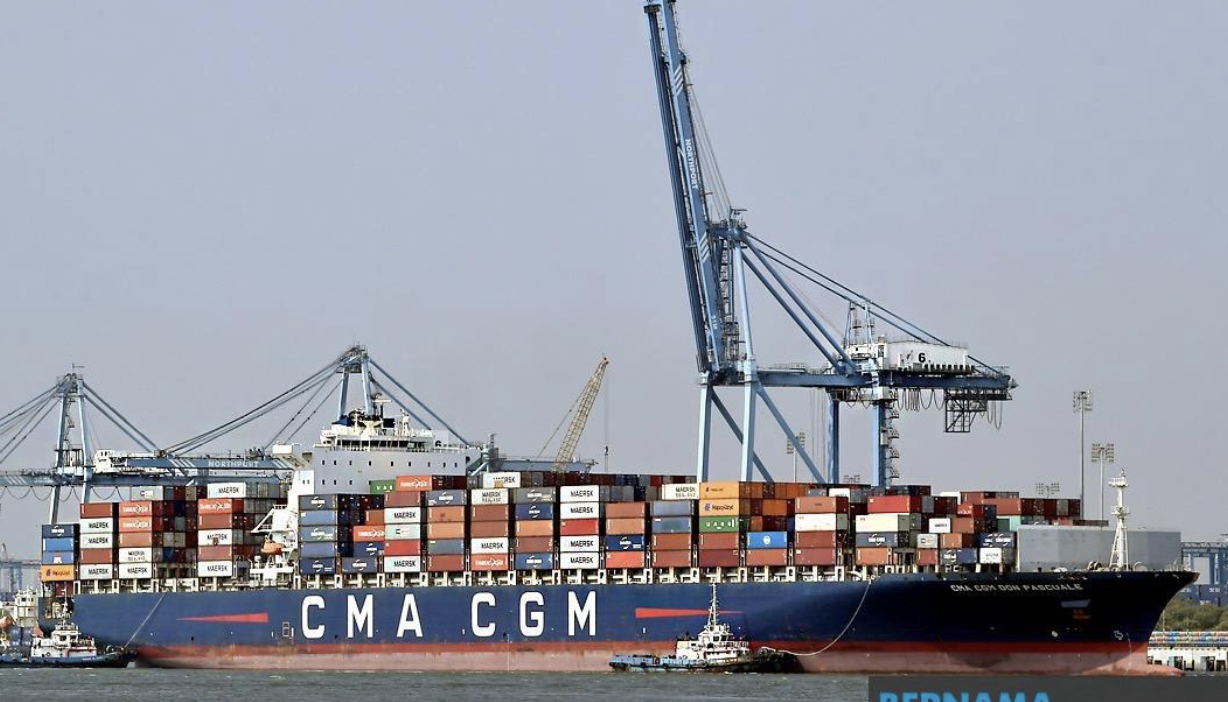
KUALA LUMPUR, Dec 7 – Malaysia’s maritime sector is sailing towards the end of 2025 in a mixed state, with sub-sectors such as ports emerging as the strongest performers due to expansion in transshipment networks through collaborations with international partners; however, shipping and haulage remain swamped by multi-pronged challenges.
From an individual port’s perspective, Malaysia’s maritime sector reached another level as Port Klang officially secured its place among the world’s Top 10 container ports in the Lloyds List of the World’s Top 100 Ports 2025, with the historic milestone being reached with the handling of 14.64 million twenty-foot equivalent units (TEUs) in 2024.
The momentum is only building as A.P. Moller – Maersk (Maersk) has launched the Maersk Mega Distribution Centre (DC) in Shah Alam, Selangor – its largest contract logistics facility in Asia Pacific – boosting its warehouse footprint by more than 30 per cent in Malaysia.
Simultaneously, MMC Port Holdings Bhd, the largest port operator in Malaysia, secured green light from the Securities Commission for its upcoming listing on the Main Market of Bursa Malaysia, resulting in a mega initial public offering (IPO), with an offer for sale of 4.27 billion shares, or a 30 per cent stake, by its sole shareholder, MMC Corp Bhd. The IPO could raise about RM8.5 billion, with all proceeds going to MMC Corporation as previously reported; however, the conglomerate has remained tight-lipped on the matter.
MMC Port manages six ports – Port of Tanjung Pelepas, Johor Port, Northport (which is also one of the two main sea gateways into Malaysia), Penang Port, Tanjung Bruas Port, and Andaman Port – as well as three cruise terminals.
Financing, Compliance, and Market Uncertainty
However, the same cannot be said for shipping, as the sub-sector continues to struggle with recurring challenges, particularly financing constraints, cost pressures, and market uncertainties.
Even with the demand generated by rerouting and movement due to geopolitical tensions throughout the year, the shipping industry continues to grapple with depleting fleets as shipowners navigate tightening compliance requirements, financing constraints, and rising operational and environmental-related costs.
The Malaysia Shipowners’ Association (MASA) chairman, Mohamed Safwan Othman, previously said that financing remains a major challenge for shipowners, on top of the need to comply with international sustainability rules. He highlighted Bank Negara Malaysia’s (BNM) crucial role in providing the right framework to improve the existing financial incentives and offer sustainable financing for the shipping industry in Malaysia.
“More participation from other banks, especially the commercial banks, is vital for the industry. We had engagements with them together with BNM. They are ready to support but need the right policy and guidance from BNM,” he added.
Mohd Safwan also pointed out that most Malaysian vessels are aging, and the cost of refleeting must consider new options like alternative fuel or dual-fuel ships. “We also welcome the news on the commitments from the government in making our ports greener, safer, and more importantly, efficient,” he said.
MASA presented the Maritime Financing Gap Analysis at the latest National Shipping and Port Council (NSPC) 2025 meeting held recently. This study identifies the key challenges faced by local shipowners in obtaining vessel financing and emphasises the urgent need for a more competitive and specialised maritime financing ecosystem in Malaysia.
The presentation received positive support from the Ministry of Transport Malaysia (MOT), BNM, and other relevant ministries and agencies, reflecting a strong shared commitment to addressing financing barriers that have long hindered the growth of Malaysia’s fleets.
Minister of Transport, Anthony Loke Siew Fook, who attended the briefing, acknowledged the current challenges in ship financing, highlighting that very few commercial banks in Malaysia are willing to finance shipowners due to the perception that the sector involves high capital requirements and limited profitability.
Loke has mandated BNM to develop a dedicated ship financing framework, with clearer regulations and guidelines to help local banks better understand the shipping industry’s operational structure and risk profile.
The meeting also saw the tabling for establishing the Malaysia Shipping Development Fund under the Merchant Shipping (Amendment) Act 2017 [Act A1551], which provides a self-sustaining financing mechanism for the development of the local shipping industry. This is also aimed at reducing reliance on the government’s annual budget allocations, supporting the implementation of the nation’s key maritime policies, and ensuring the continuity of 100 per cent corporate tax incentives for local shipping companies.
Regulatory Shifts and Industry Pressures
The ambitious targets are also aligned with Malaysia’s aim in enhancing connectivity, and shifting freight from roads to rail to reduce road congestion and environmental impact, a key part of the National Transport Policy (NTP) 2019-2030.
Malaysia’s NTP aims to shift freight from roads to rail by improving rail infrastructure, capacity, and services. In this “Road to Rail” shift, hauliers play a crucial role in connecting the “last mile” between rail hubs, seaports, and airports to ensure seamless logistics.
The Association of Malaysian Hauliers (AMH) executive secretary Mohamad Azuan Masud said the plan is a positive step that can ease congestion in major ports, reduce dependence on road capacity, and enhance overall efficiency, especially in Johor, where volume and traffic are at critical levels.
However, he also pointed out that the container haulage industry is facing operational challenges and cost implications due to the adaptation to the Speed Limitation Device (SLD) requirement and the BGK/BDM weight upgrade, which were introduced last year.
“In the national Overweight Enforcement Policy during the National Logistics Task Force (NLTF) meeting, container hauliers were the first sector chosen for nationwide implementation, making us the test bed for the country’s transport reforms,“ he told Bernama.
He also said that hauliers are governed by multiple layers of national and international regulations and face greater compliance complexity compared to other transporters.
Among the regulators are the Road Transport Department, Land Public Transport Agency, port authorities, and terminal operators, alongside global standards such as the Verified Gross Mass regulation under the International Convention for the Safety of Life at Sea, Mohamad Azuan said. “That momentum has continued this year with the enforcement of the overweight policy, the rollout of SLD requirements, and soon the introduction of High-Speed Weigh-In-Motion (HS-WIM) systems. Together, these represent the most significant regulatory shift our industry has faced in over a decade.”
Commenting on haulage rates, Mohamad Azuan said rates have remained stagnant since the enforcement of the Competition Act 2010, which indirectly led to stagnant tariff rates. “In fact, rates have declined due to oversupply in the market. The uncontrolled issuance of new haulage licences has worsened this, leading to severe price competition where some operators undercut just to stay afloat,” he added.
He warned that with new compliance costs and operating expenses rising, 2026 could be a challenging year. “We expect to see more consolidation; some operators may close, while new entrants continue to come in and try their luck. It is a highly competitive but fragile landscape,” he said.
Asked about the outlook for next year, Mohamad Azuan said most hauliers are under pressure with profit margins shrinking, and multiple new policies being enforced simultaneously.
“However, we do acknowledge that MOT has consistently engaged the industry and assured us that our interests are being considered,” he added. “Hauliers are not asking for special treatment – only for fair timelines, coordinated enforcement, and recognition of the vital role we play in keeping Malaysia’s supply chains moving.”