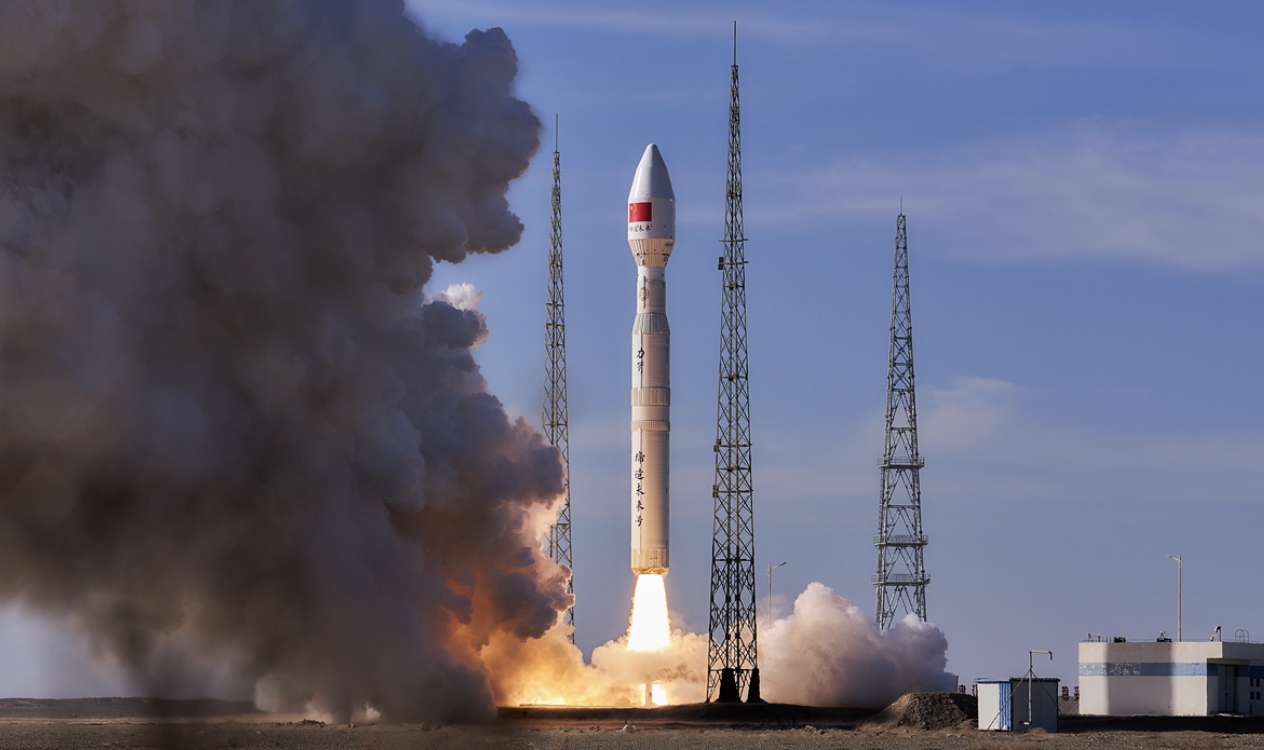
BEIJING, Dec 10 – China on Wednesday launched the Lijian-1 Y11 carrier rocket with nine satellites onboard, including three international payloads for the United Arab Emirates (UAE), Egypt and Nepal. After delivering the nine satellites to their preset orbits, the launch mission was declared to a complete success.
According to the rocket developer CAS Space, most of the satellites, owned by the Chinese Academy of Sciences (CAS) will support applications including urban planning, disaster prevention and mitigation, water resources, and meteorology.
The “UAE-813 Satellite” launched in the Wednesday mission was developed by the Shanghai-based Innovation Academy for Microsatellites of CAS. It is a hyperspectral Earth observation satellite. It carries primary payloads including a hyperspectral imager, a panchromatic camera, and an atmospheric polarization corrector, along with the construction of corresponding ground systems.
The core aim of the project is to build hyperspectral remote sensing capabilities, thereby providing effective support for environmental monitoring and scientific research, according to the CAS Space.
The SPNEX satellite, also aboard the Lijian-1 rocket on Wednesday in the flight mission, was jointly developed by the Egyptian Space Agency and the Egyptian Academy of Scientific Research and Technology. It carries plasma diagnostic and Earth observation payloads, with its primary mission of monitoring the impacts of climate change and ionospheric variations.
The Slippers2Sat (S2S) satellite is an educational project jointly launched by Antarikchya Pratisthan Nepal and the Amateur Radio Digital Communications Foundation. The project is dedicated to inspiring, motivating, and providing educational support to marginalized groups, low income communities and indigenous populations in Nepal.
The project’s main goal is to help Nepali junior-high students independently design and build Nepal’s third 1U CubeSat while demonstrating and promoting a software-based digital repeater system in amateur radio bands for global amateur-radio users.
CAS Space has now served a total of 32 satellite customers, 26 domestic and six international. Its launch-service footprint extends across China, Europe, North America, South Asia, the Middle East, North Africa, and other countries and regions.
The Wednesday mission marked the 11th orbital flight of the Lijian-1. The rocket model has delivered 84 satellites to space with a total in-orbit payload mass exceeding 11 tons, leading the market share in the country’s commercial rocket launch service sector, according to the CAS Space.
Shi Xiaoning, chief designer of the Lijian-1 rocket, told the Global Times on Wednesday that next, the CAS Space also plans to validate rocket recovery and reusable technologies using its Lihong series spacecraft, targeting breakthroughs in parachute-assisted recovery, precise grid-fin landing control, multiple in-flight restarts of reusable liquid engines, and deep throttling capability.
Once matured, these technologies will be applied to suborbital scientific experiments, commercial space tourism, and the recovery and reuse of launch vehicle stages, Shi said.
According to the Xinhua News Agency, the CAS Space unveiled reusable spacecraft codenamed Lihong series in September this year.
The spacecraft is China’s first fully reusable vehicle built specifically for space tourism that can complete more than 30 flights while offering safe, reliable and cost-effective shuttle services. It is also designed to serve as a space laboratory for research on microgravity and radiation, advancing China’s crewed lunar and deep-space goals, per the Xinhua report.
In the future, Lijian-1 will incorporate parachute recovery and grid-fin control systems, and advance fairing recovery and reuse, along with precise impact-point control of spent stages. These upgrades will significantly enhance mission flexibility and further reduce launch costs, the rocket designer said.