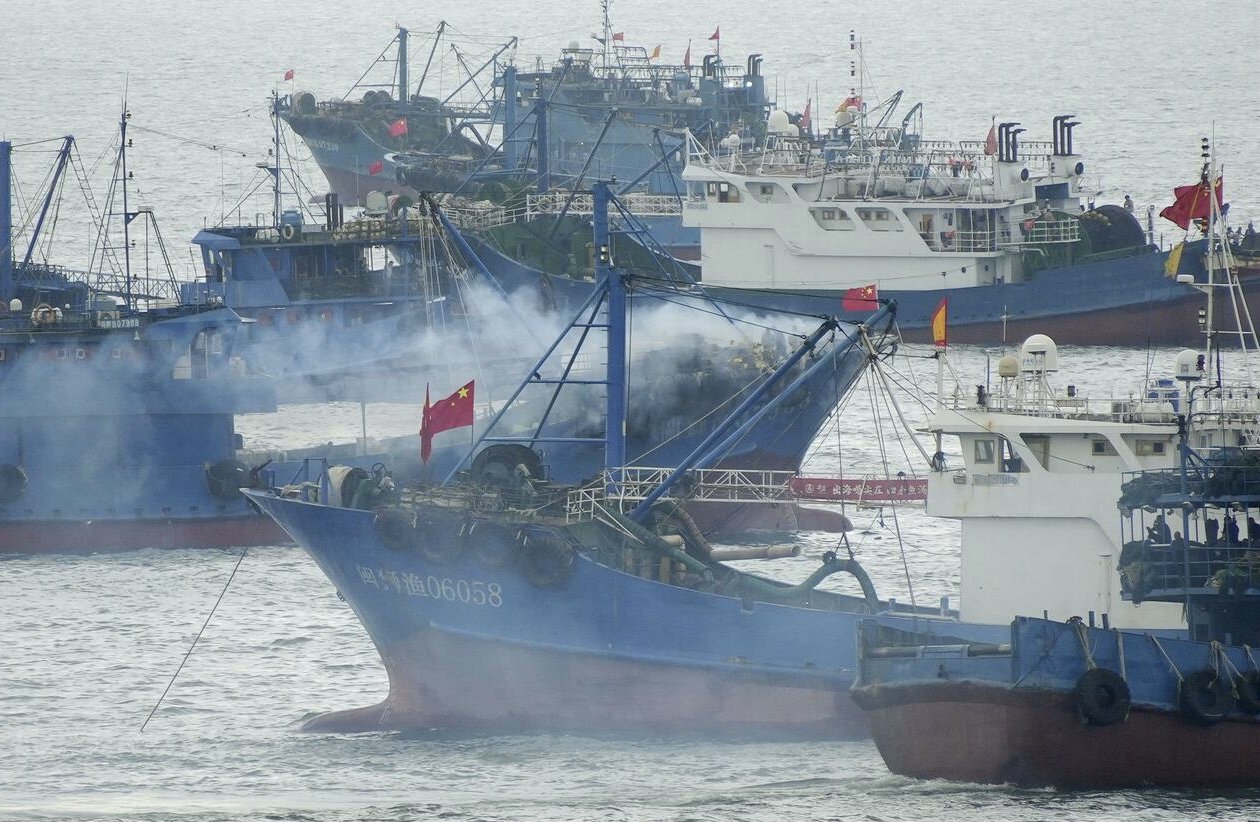
BEIJING, Feb 8 – Up to 2,000 Chinese fishing boats have gathered near the Sino-Japanese median line in the East China Sea at least twice since late last year, forming a floating wall stretching more than 400 kilometers, according to a geospatial data analysis company.
Experts believe ordinary fishers were mobilized as maritime militia to form a barrier blocking access by other vessels in the area, and that similar activities are likely to continue, becoming a new normal.
The Tokyo-controlled Senkaku Islands, claimed by China, lie in the East China Sea. Beijing regularly sends its ships near the islets to press its territorial claim, referring to them as Diaoyu.
According to data collected by ingeniSPACE using an automatic identification system to track vessels, about 2,000 Chinese fishing boats formed a U-shape measuring around 470 km in length and 80 km in width between Dec. 24 and 26 on the Chinese side of the median line between the two countries’ shorelines.
On Jan. 11, about 1,500 Chinese fishing boats lined up across more than 400 km in waters straddling the median line.
Chisako Masuo, a professor at Kyushu University who conducts joint research with ingeniSPACE, said the fishers were believed to have joined Chinese military drills, possibly led by veterans. Their activities were monitored before mainland forces staged large-scale exercises surrounding Taiwan at the end of the year.
In August 2016, up to 300 Chinese fishing vessels approached the Senkaku Islands, with some repeatedly entering Japanese territorial waters and escalating tensions between the two Asian countries. The number of boats detected by the data analysis company far exceeds that level.
Masuo pointed out that since 2013, China has developed technology to contact fishing boats scattered in wide sea areas and mobilize them for national defense missions.
Although fishing vessels are not obliged to load the automatic identification system, boats that were recently mobilized in the East China Sea sent signals in an apparent demonstration of their activities, the professor said.
“Amid an escalation of Sino-Japanese tensions since November, the boats were intended to issue a warning against Japan and Taiwan,” Masuo said, referring to a diplomatic row over Prime Minister Sanae Takaichi’s parliamentary remarks suggesting Tokyo could act in the event of an attack on the self-ruled island claimed by Beijing.
She urged the Japanese government to enhance cooperation with the private sector to better monitor Chinese maritime activities through intelligence data analysis. – Kyodo news agency