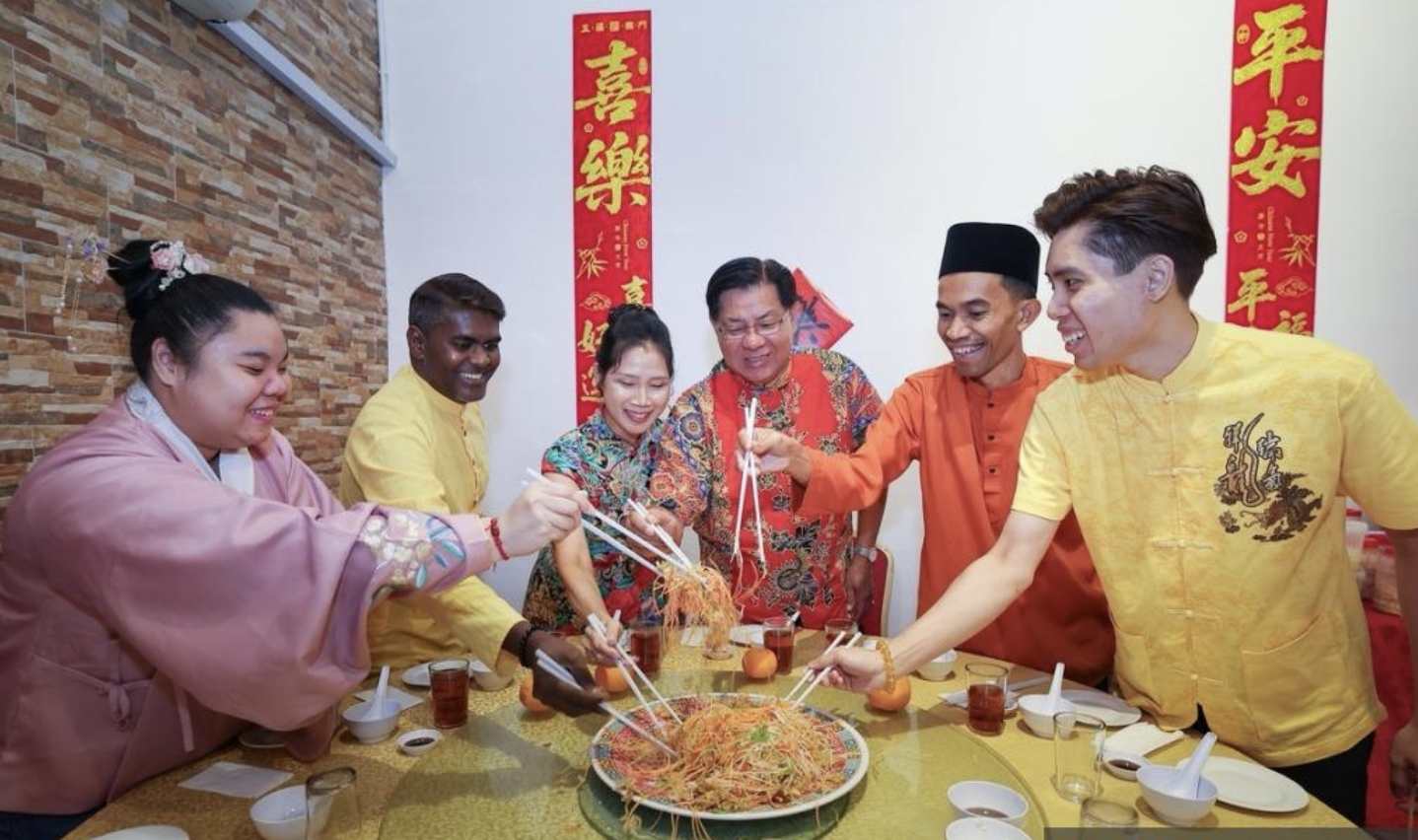
KUALA LUMPUR, Feb 16 — The tradition of the reunion dinner in conjunction with Chinese New Year celebrations nationwide continues to be a symbol of racial unity in Malaysia. Today, the dining table not only celebrates ancestral heritage but also the diverse palates of its people.
This unique, long-practiced cultural tradition proves that differences in background and religion are no obstacle for families to keep traditions alive, subsequently strengthening the bonds of kinship in a harmonious and goodwill atmosphere.
In KUALA LUMPUR, Nur Liyana Abdullah, 66, formerly known as Lee Kim Bee, expressed her gratitude that her family’s reunion dinner does not just feature traditional Chinese dishes, but also incorporates elements of Malay and Indian cuisine.
“I wanted something a little different. My siblings are used to eating Chinese food every day, so they really enjoy Malay dishes because they rarely get them. Moreover, we grew up in a plantation village, so sambal petai is a firm favorite,” said Nur Liyana, who embraced Islam over 30 years ago.
According to her, her elder sister arrived a day early at their family home to prepare traditional dishes such as nán rǔ cū zhāi (vegetable stew) and ginger steamed chicken, while Nur Liyana took on the role of preparing cross-cultural dishes like sambal udang petai, chicken rendang, and Indian delicacies including wade and spiced chickpeas for the whole family to enjoy.
In NEGERI SEMBILAN, although most Chinese eateries and restaurants were packed with patrons, many still chose to gather at home with family members for the reunion dinner to welcome the Year of the Horse.
Private sector worker Jenny Tan, 38, said she and her family chose to prepare their own meals and eat at home with her two siblings.
“Last year we ate at a restaurant, but this time my mother and I agreed to cook together. This is important- besides strengthening family ties, we also hope the dishes we cook can bring back childhood nostalgia,” said Tan, who works in Kuala Lumpur and returned to her family home in Rasah, Seremban, for the festivities.
In PERAK, local news agency photographer Alan Teh, 65, described the Chinese New Year Eve reunion dinner as a mandatory event that must be attended by immediate family members at his residence in Taman Timah, Ipoh.
The father of two said the tradition is not just about enjoying a meal, but is a symbol of unity where all family members gather at one table to share stories and strengthen their bonds.
“My family is small, so we celebrate modestly. However, I make sure my two children, Teh Mun Yee, 31, and Teh Kuan Yee, 27, return home for this event. Dishes like chicken, fish, and vegetables are mandatory menus that must be present to complete our reunion dinner every year,” he said.
In KEDAH, Tan Siew Eng, 62, from Simpang Empat, Alor Setar, said this year’s reunion dinner was extra meaningful with the return of his 12-month-old granddaughter, as well as his son and daughter-in-law who are currently residing in Sydney, Australia.
“Last year, my son and daughter-in-law celebrated Chinese New Year abroad, but this year they returned to celebrate with us… I am even happier to meet my granddaughter for the first time; this year’s celebration is truly meaningful,” he said.
A similar sentiment was felt in TERENGGANU, where the reunion dinner for Toh Ping Ping’s family, 45, from Taman Sri Manir, Kuala Terengganu, was made more significant by the return of her brother, Toh Kai Wen, 50, from Australia.
Ping Ping said that after living in the “Land of the Kangaroo” for nearly 25 years, her eldest brother finally decided to return and settle in Kuala Lumpur with his wife and two sons. To celebrate his return, their mother prepared not only traditional Chinese dishes like Yee Sang and roast duck but also ordered nasi minyak, which is her brother’s favorite.
In PENANG, the atmosphere at residences and restaurants around the city began to buzz with preparations for special dishes such as yee sang, chicken, roast duck, steamed fish, and various other traditional delicacies that symbolise prosperity and abundance.
For Jennifer Ling, 32, an engineer at a factory in Batu Kawan, the reunion dinner is the most anticipated moment of the year as it brings the whole family together, including those returning from abroad.
“Even though my siblings are busy working in Kuala Lumpur, Johor, and Singapore, they still make an effort to return for the reunion dinner. This is the time for us to sit at one table, share stories, strengthen family ties, and celebrate Chinese New Year,” she said.
In SIBU, driving academy manager Tiong Sie Kiong, in his 40s, decided to make a change by holding the reunion dinner at a leading hotel in the town.
“Since I was born, our family’s reunion dinners were held modestly but merrily at home. For the past 10 years, I took over the responsibility of hosting it at my home in Jalan Ding Lik Kong.
“This year, coincidentally, a leading hotel in town offered me a special deal to hold the tradition there. Most of the preparations were handled by the hotel, including the must-have menu, Yee Sang, also known as Yusheng or Lou Sang,” he said.
In SABAH, the Chinese New Year reunion dinner remains an essential tradition among the Chinese community as a symbol of family unity, gathering once a year before the festival begins.
Sabah and Labuan Chinese Chamber of Commerce Deputy Secretary Weal Cheoh said the reunion dinner carries deep meaning as it brings together family members from various locations to enjoy a meal together.
In PERLIS, although his parents have passed away, the spirit of family remains the pillar of Chinese New Year for Kang Terry, 45, from Pauh in Arau, as he gathered for a reunion dinner with his siblings.
Kang, who lives with his elder sister, said even though his brother and two younger sisters work and live far from Perlis, they ensure they do not miss the annual gathering to continue the reunion dinner tradition.
Kang said the dinner, held at around 7:30 pm, is the most anticipated moment because it is not just about sharing a meal, but also about strengthening family ties that are tested by work commitments and distance.
In MELAKA, the tradition of having the reunion dinner at home continues to be upheld by Kew Li Wen, 33, as a way to show gratitude for family relationships.
Kew, who resides in Banda Hilir, said her family prefers eating at home over restaurants as it is more comfortable and intimate, given that all family members help their mother cook various dishes.
“Even though it is simple, it brings extraordinary joy to our family because eating at a restaurant feels very different in terms of taste and atmosphere,” she said.
In PAHANG, the tradition of ‘tuan yuan’ or the reunion dinner on the eve of Chinese New Year is a pivotal moment for Foo Pei Sun’s family.
The 38-year-old woman entrepreneur said one of the mandatory menus served during the reunion dinner is ‘sang choi’ (lettuce), which symbolises prosperity and abundance in the new year.
In SELANGOR, nearly 1,110 members of the Teochew community gathered to celebrate a reunion dinner that was not only festive but served as a platform to reunite the community and strengthen ties with society.
National Teochew Association Vice President Datuk Seri Teh Meng Huat said the celebration is not just an annual event but a crucial moment to reinforce family bonds, appreciate elders, and sow new hopes.
“This event has been running for 14 years, and its purpose is for people to meet and get to know one another, especially the elderly who have been drifted apart by the tides of modern technology,” he said when met at the Reunion Dinner organised by the Klang Coastal Teochew Association at SJKC Pandamaran A today.