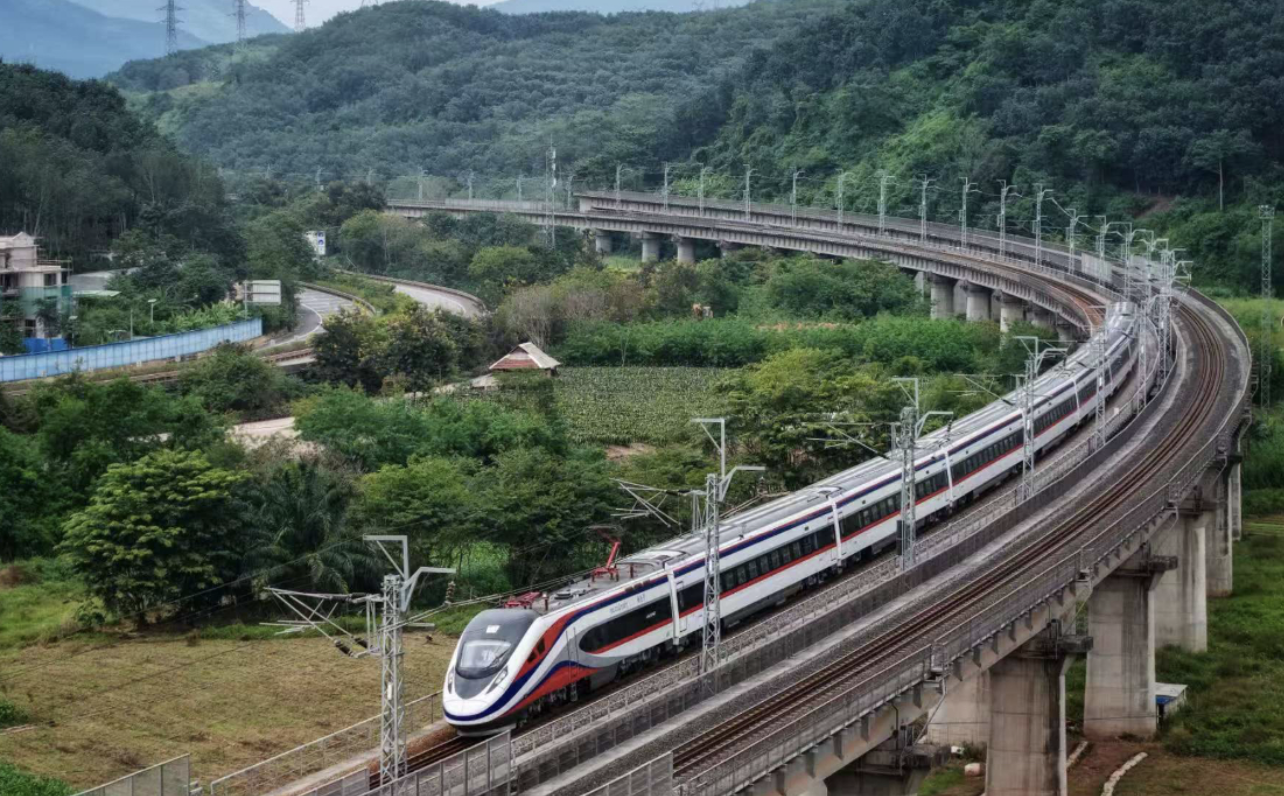
BEIJING, Dec 2 – The China-Laos Railway has marked four years of safe operations, handling more than 62.5 million passenger trips and 72.5 million tons of cargo as of Tuesday, with its “golden corridor” effect continuing to expand and support regional development, according to China State Railway Group (China Railway).
Over the past four years, passenger traffic has risen sharply in both volume and quality. Monthly ridership along the line has climbed from 600,000 at the start of operations to a peak of 2.2 million.
On the China section, daily passenger services have increased from eight to as many as 86 trains, carrying a total of 51.34 million travellers.
On the Laos section, daily passenger services have grown from four to as many as 18 trains, with standard trains expanded to more than 10 carriages and cumulative ridership reaching 11.24 million, according to the data from China Railway.
Railway authorities in China and Laos have continued to improve onboard and station services, rolling out a range of measures to make travel more convenient and passenger-friendly.
Train meals have become particularly popular among travellers from different countries, and “traveling to China by train” and “traveling to Laos by train” are now top choices for many cross-border tourists.
On the Laos section, the launch of express delivery services on standard passenger trains — with same-day delivery available — has handled 1.26 million parcels to date, giving a notable boost to the country’s e-commerce sector.
Somyang Vilavsouk, a Lao tour guide, said that China’s Xishuangbanna has become an increasingly popular destination for travellers from Laos and Thailand. “They love China for its natural beauty, rich culture and overall sense of harmony.”
Freight volumes have also climbed sharply, underscoring the railway’s growing role as a major logistics corridor. The China-Laos Railway has created a faster, more cost-efficient route between China and ASEAN, driving strong demand.
Daily cross-border freight services have increased from two to a peak of 23 trains, with hauling capacity rising from 2,000 to 2,800 tons.
More than 16 million tons of goods have been moved so far, reaching 31 Chinese provinces and 19 countries and regions including Laos, Thailand, Malaysia, Singapore and Vietnam, with the range of transported goods expanding to over 3,800 categories.
Li Gengui, a Chinese foreign trade merchant, said the China-Laos Railway has been “a real benefit” for businesses. “It has truly sped things up and lowered costs.
For products like tea and durian, there’s far less transport loss and storage pressure, and overall costs are down by roughly 20 percent. Customs clearance is faster too, and two-way trade just keeps growing,” he said.
The railway’s spillover effects are increasingly evident, particularly in tourism. Railway authorities in China and Laos have worked with tourism departments to make use of visa-free transit policies and promote integrated “rail + tourism” products.
New routes between Kunming and Vientiane now offer a range of travel options to Laos. So far, 640,000 travellers from more than 120 countries and regions — including Laos, Thailand, Malaysia, the US and the UK — have taken cross-border international passenger trains, driving up demand for scenic attractions, hotels and dining along the route.
The railway has also accelerated the movement of people, goods, capital and information across the region, sharply reducing logistics costs.
Freight costs on routes from Kunming through Laos to Thailand have dropped by 30 to 50 percent, while transport costs within Laos have fallen by 20 to 40 percent, giving the country and its ASEAN neighbors a major efficiency boost.
These gains have made the corridor a new driver of regional growth. Governments and businesses in both countries have planned or built more than 40 industrial and logistics parks along the line, including hubs for steel, nonferrous metals and rubber, as well as emerging clusters in batteries, biomedicine, new materials and advanced manufacturing, supporting industrial upgrading and deeper cross-border trade.
China has also stepped up efforts to train Laos’ first generation of railway professionals, with Chinese instructors providing extensive hands-on guidance.
A total of 1,252 Chinese managers and technicians have been dispatched to Laos, completing 1,475 qualification training sessions for local staff.
Thirty-two Lao train drivers have obtained operating licenses and can now operate locomotives independently, while 82 assistant drivers, 16 conductors and 160 team leaders have also been trained, forming the country’s first cohort of skilled railway personnel.