BEIJING, Sept 2 – The land route to Gyirong Port in Gyirong County, Southwest China’s Xizang Autonomous Region, had been fully reopened at 10 am on Wednesday, allowing rescuers, relief supplies, equipment and heavy machinery to reach the core disaster area by road to carry out more intensive rescue operations, Xinhua News Agency and CCTV News reported on Wednesday.
Road-clearing operations along national highway G216 have reached the core disaster area, where search and rescue efforts are being carried out through coordinated use of multiple methods. The last section of the road cut off by water has been temporarily restored, allowing heavy machinery to pass through, according to CCTV News.
In the core disaster-hit area at Gyirong Port, operations of heavy machinery clearing national highway G216 has reached an area close to the original site of the Chinese-side Gyirong Port building.
After days of continuous emergency efforts, parts of the road surface of G216 have re-emerged by Tuesday, with yellow road markings becoming visible in some sections.
A mudslide on the Nepalese side of the border on the morning of August 26 affected Gyirong Port in Gyirong County, causing serious casualties and leaving many missing. The disaster previously cut off traffic along national highway G216 leading to Gyirong Port.
In the early stages of the rescue operation, rescue teams could only conduct preliminary grid searches in the core area of the port on foot, assisted by drone search and the aerial delivery of light equipment. With the land access route now reopened, rescue teams have promptly adjusted their tactics in response to the changing conditions, the Global Times has learned.
Under the new search-and-rescue approach, large engineering machinery is deployed first to clear obstacles and open up working areas, followed closely by professional fire and rescue teams conducting targeted searches, with life-detection equipment used to verify specific locations.
Rescue personnel are following closely behind the machinery to carry out detailed searches in areas covered by piled boulders, buried structures and sediment along river channels, ensuring that targeted search-and-rescue operations advance wherever mechanical clearance work reaches.
Before the reopening of the route to the Gyirong Port, the damaged road was covered in thick mud, blocking passage for large vehicles and making it extremely difficult for rescuers to advance on foot, according to the rescue teams, Xinhua reported.
On the debris-strewn river banks and along the steep mountain slopes, rescue teams brought search dogs through the gaps between twisted steel bars and massive boulders, scouring the affected areas for any sign of life.
“In places where the mud is deep, half of your body can sink in, and every single step drains all your strength,” said a rescue team member. “But we will not give up on any corner.”
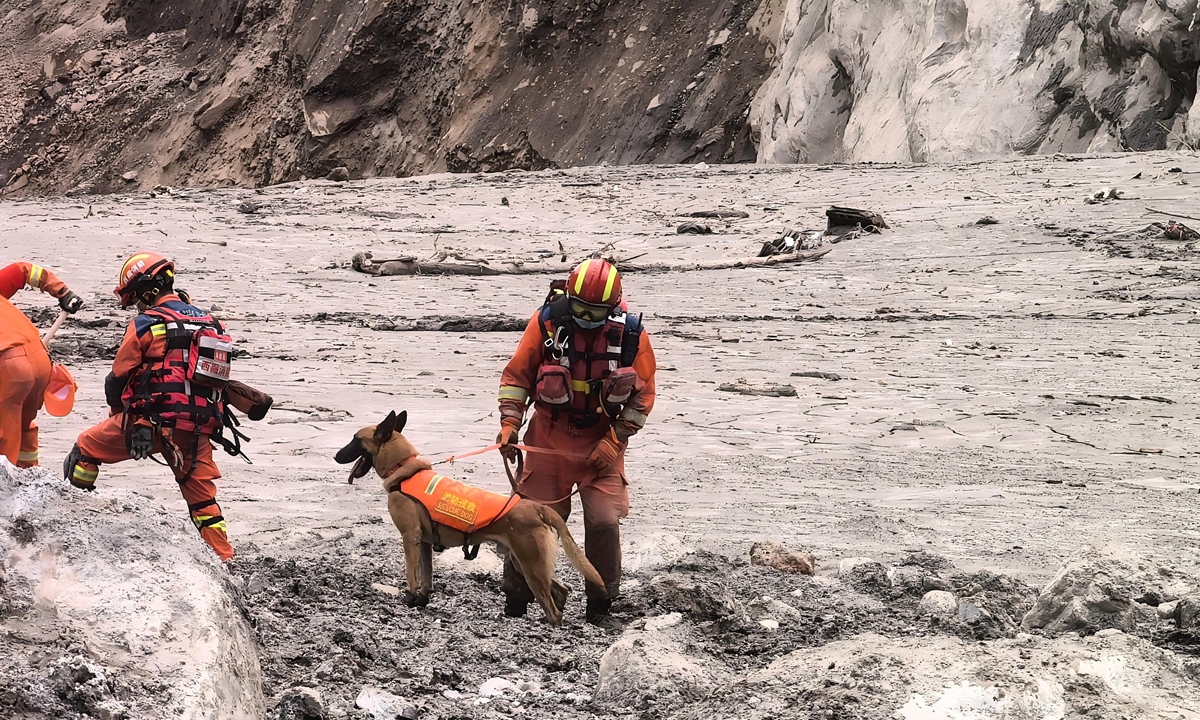
Rescue team members with a search dog carry out rescue operations, looking for any sign of life. Photo: Courtesy of China’s national comprehensive fire and rescue teams So far, more than 2,000 personnel have joined the search and rescue operations, including those from the People’s Liberation Army, the People’s Armed Police Force and China Anneng. Despite difficulties such as high-altitude terrain, steep valleys and volatile weather, the rescue forces have been working around the clock to search for survivors, repair roads, set up communication base stations and restore power lines, Xinhua reported.
Going forward, fire and rescue teams will coordinate with other rescue forces to expand deeper and more comprehensive searches across the disaster-hit area, checking every possible buried blind spot and continuing efforts to locate the missing.